

Bruce Goff was born in a farm town in north-central Kansas, trained in Tulsa and did his best-known work in Norman and Bartlesville, so a weekend of his architecture is a weekend on the highways of Oklahoma and southern Kansas. Some buildings can be entered, some only seen from the sidewalk, and one of the most famous, the Bavinger House, no longer exists. This guide lays out a route with real driving distances, what is open to the public, the best months to go, and how to behave outside houses where people still live.
Friday evening and Saturday morning: Tulsa’s Art Deco
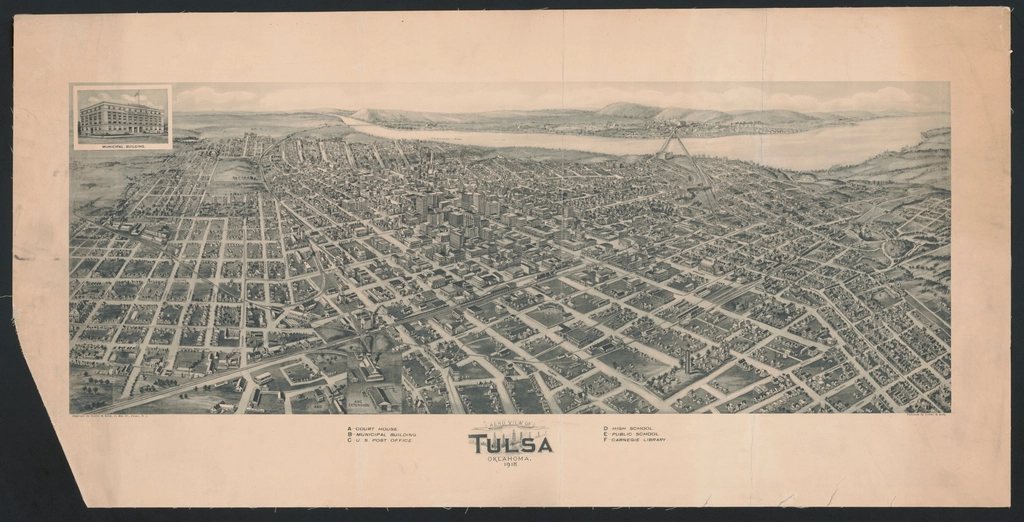
Tulsa’s oil money arrived in the 1920s, exactly when Art Deco arrived from Paris, and the result is one of the densest concentrations of Deco buildings in the United States, most of it within a fifteen-minute walk downtown. Start at the Boston Avenue Methodist Church, completed in 1929, where Goff, then in his early twenties, produced the design with his former art teacher; the division of credit between them was disputed for decades. The church is a National Historic Landmark and a working congregation, and docent-led visits are generally offered after Sunday services and by arrangement, so check the schedule if you want to see the sanctuary rather than just the tower.
From the church, walk north through downtown. The Philtower of 1928 and the Philcade of 1931 face each other across Fifth Street, and the Philcade lobby houses a small free museum of Deco objects. The Tulsa Union Depot and the Tulsa Fire Alarm Building, both of 1931, are a short walk further. Goff’s own hand in the city goes beyond the church: the Tulsa Club Building of 1927 and a small 1929 studio on Riverside Drive, now a community theater, are both his. Allow a full morning.
Saturday afternoon: Bartlesville
Bartlesville is 47 miles north of Tulsa on US-75, about an hour’s drive. The reason to go is Frank Lloyd Wright’s Price Tower of 1956, nineteen stories and 221 feet tall, his only realized skyscraper, standing in a small downtown that has no other building half its height. Tour arrangements for the tower have changed more than once in recent years, so confirm what is open before you drive. Even from the street the copper fins and the cantilevered floors are worth the trip.
Goff is here too, quietly. The Redeemer Lutheran Church, designed by Goff in the late 1950s, is a working church with his characteristic glass cullet and timber, and visitors are usually welcome around services. What you will not find is the Shin’enKan, the house Goff developed for the tower’s patron from 1956 into the 1970s; it burned in 1996 and was cleared afterward, and the site is private land. Bartlesville makes a sensible overnight stop, within reach of either Sunday option below.
Sunday, option south: Edmond and Norman
If Goff’s Oklahoma houses matter more to you than Wright’s, drive south. Bartlesville to Edmond is roughly 120 miles, about two hours via Tulsa and the Turner Turnpike, and the reward is the Hopewell Baptist Church, begun in 1948 and framed with oil-field pipe in a form that reads as a tepee from the road. It is listed on the National Register and is visible from the public road whether or not the building itself is open.
Norman is another 35 miles south, past Oklahoma City. This is where Goff chaired the University of Oklahoma’s School of Architecture from 1947 to 1955. The Ledbetter House of 1947, a few blocks from campus, is a private residence easily seen from the sidewalk, with its carport hung from a mast by cables, a first sketch of the idea he used at the Bavinger House. The Bavinger House itself, east of town, was demolished in 2016, and its site is private property with no marker and nothing to see; do not go looking for it. The university’s art museum and architecture library hold Goff material and are the right places to end the day.
Sunday, option north: Wichita and the Kansas connection
If you prefer Wright and want to touch Goff’s origins, drive north instead. Wichita is roughly 140 miles from Bartlesville, about two and a half hours on two-lane US highways, or about 180 miles and three hours from Tulsa. The Allen House, designed by Wright in 1915 and finished in 1918, is one of the last of his Prairie houses and is open for guided tours by reservation; it is the best interior on this whole route. At Wichita State University, the Corbin Education Center of 1963 is a Wright design completed after his death and can be walked around freely.
Goff’s Kansas is thinner on the ground. He was born in Alton, in Osborne County, in 1904, some 200 miles further north-west across the wheat country, a pilgrimage for another trip. A handful of private Goff houses from the 1960s stand on the Kansas side of Kansas City, roughly 200 miles north-east, street-view only. Neither fits in a single weekend.
Seasons, timing and the road
Weather is the main variable. April and May bring green hills and comfortable temperatures but also the peak of tornado season, which runs from April through June; watch forecasts and do not drive into a warned storm to keep a schedule. July and August regularly push above 95 degrees Fahrenheit, so finish any downtown walk by eleven. October is the safest month for light, temperature and long days on the road. Winter is short but can include ice storms that close the turnpikes for a day at a time.
All of the route is in the Central time zone. Churches on this route are churches first, so plan sanctuary visits around services. Fuel is plentiful on US-75 and the turnpikes and sparse on the Kansas two-lanes north of Bartlesville; fill up before the state line.
Etiquette outside private houses
Most of Goff’s surviving houses are private homes, and the people in them did not sign up to be a tourist attraction. A short code keeps the goodwill that lets these houses stay visible.
- Stay on the public sidewalk or the public road. Do not step onto the lawn, the driveway or a private lane, even for a better angle.
- Photograph the building, not the windows. Long lenses pointed at glass are the fastest way to get a hedge planted.
- Keep it short. A few minutes and a few frames; no tripods, no picnics across the street.
- No drones. Low flights over houses are restricted, and the noise ends the visit for everyone.
- Do not knock, ring or ask to see inside. If the owners want visitors, the house will be on a tour, and it will say so.
- Park legally and never block a driveway or a rural gate, especially on the narrow roads east of Norman.
Followed on both sides of the state line, the route gives you a Goff church you can enter, a Wright tower and a Wright house you can visit, a city’s worth of Deco, and the outlines of two demolished masterpieces you will have to imagine: a fitting weekend for an architect who insisted no two buildings should be alike.
