
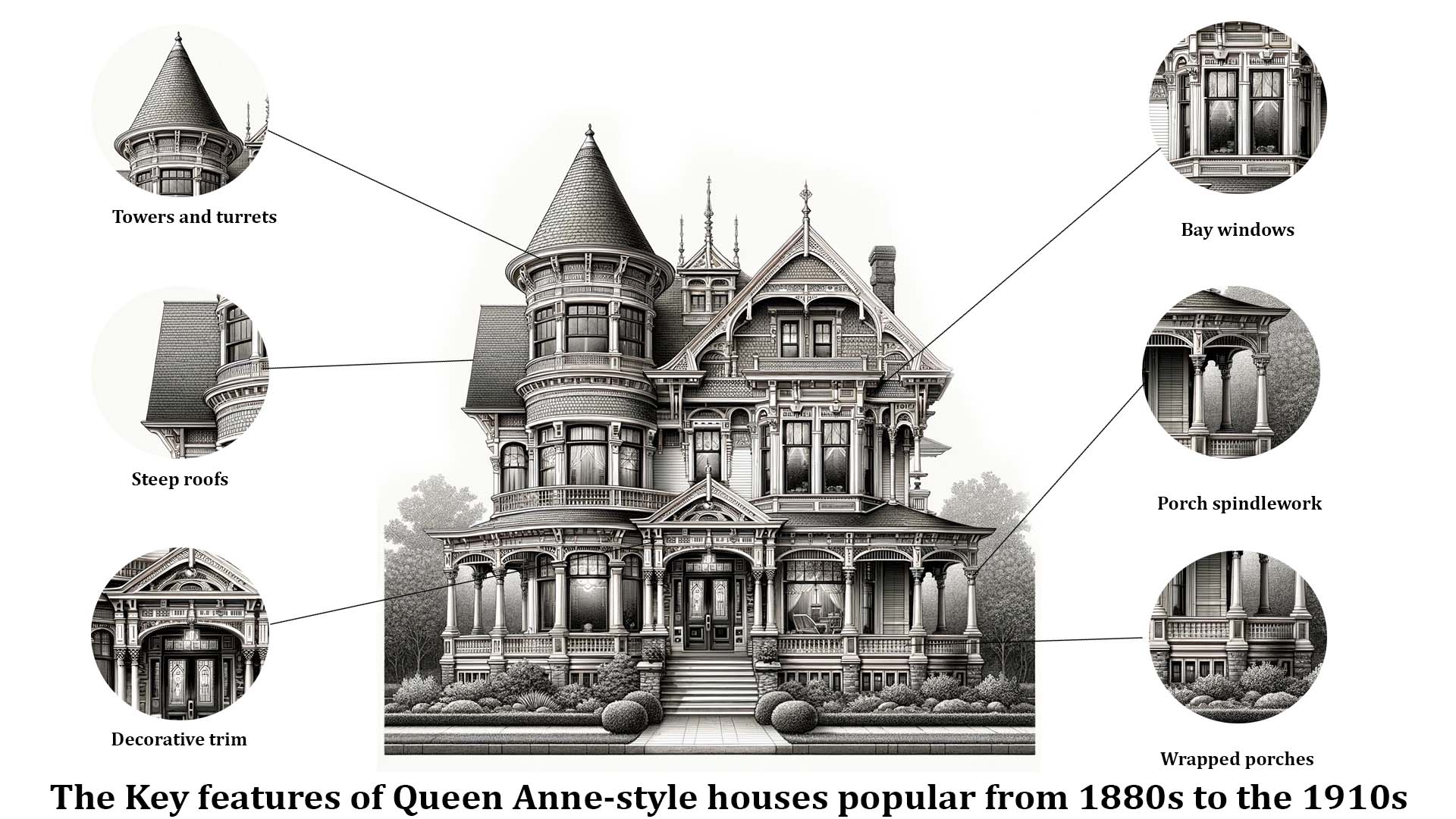

The Queen Anne architecture style names two different things. In Britain, it can mean the restrained English Baroque of Queen Anne’s own reign, from 1702 to 1714. It can also mean the Revival of the late 19th century. In North America, it usually means the towered, ornamented Victorian house. Knowing which one you face changes what you look for, and what you can expect when you book a stay.
What does Queen Anne style actually mean?
The name causes confusion. It points to a queen, but the label covers more than one look.
The first meaning is English Baroque from the reign of Queen Anne. She ruled from 1702 to 1714. The second is the British Queen Anne Revival. It became popular late in the 19th century and ran into the early decades of the 20th.
A third meaning exists outside Britain. In other English-speaking regions, the New World revival produced entirely different styles. Do not expect a match with early 18th-century English buildings. In the United States, the style normally includes no elements typical of the architecture of Queen Anne’s reign. The names were devised for marketing purposes.
One Canadian source adds a useful point. It describes Queen Anne as one of several styles grouped under the Victorian heading. Victorian is an era. Queen Anne is a single architectural expression within it.
The same source places the style at 1870 to 1910. That timing is why the name feels odd. The house style appeared long after the queen herself.
How do you spot the original English version?
The English Queen Anne building is calm and orderly. It is mostly a domestic style. Think of buildings up to the size of a manor house, usually designed by local builders or architects.
Symmetry is the key. The English form is characterised by strongly bilateral symmetry. The front elevation often carries an Italianate or Palladian-derived pediment.
Architectural historian Marcus Binney, writing in The Times in 2006, listed typical features:
- Steps that sweep up to a carved stone door surround.
- Painted sash windows in neat rows, flush with the brick.
- A central triangular pediment set against a hipped roof with dormers.
- A boxy plan, two rooms deep.
Color and material matter too. Walls use carefully chosen red brick. Details appear in a lighter stone, often richly carved. Christopher Wren used this technique in his rebuilding of Hampton Court Palace. It gave a rich effect at a lower cost than facing the whole building in stone.
Binney called Poulton House in Poulton, Wiltshire, built in 1706, Queen Anne at its most delightful. Use it as a mental model. Brick, pale stone, neat windows, balanced front.
What marks the Victorian Revival and the American house?
The Revival looks nothing like the original. It is asymmetrical and picturesque.
In Britain, George Devey and the better-known Norman Shaw popularized the style in the 1870s. Shaw’s eclectic designs often included Tudor elements. That Old English look also reached the United States, where it was inaccurately called Queen Anne. American commercial builders adopted it quickly.
The British Revival shares features with the American one. Look for these:
- Fine brickwork with a warmer, softer finish.
- Terracotta panels, or tiles hung on the upper storeys.
- Crisp white paint or pale limestone trim.
- Projecting oriel windows, often one above another.
- Uneven fronts and a picturesque, irregular outline.
British Revival work sits closer to the Arts and Crafts movement than its American counterpart. Edwin Lutyens later used an elegant version, with red brick walls against pale stone.
In the United States, the label covers a wide range of picturesque buildings. It applies to architecture, furniture and decorative arts of roughly 1880 to 1910. Some elements, such as the wraparound porch, lasted into the 1920s.
What features define the American Queen Anne house?
This is the house most people picture. A Canadian source notes that when people describe a Victorian home, they usually envision a Queen Anne.
The defining idea is variety. Wall planes and forms change constantly. Towers, overhangs and wall projections break up flat surfaces. The style is marked by eclecticism, asymmetry and excess.
Look for this checklist:
- A tower, round, square or polygonal.
- A dominant front-facing gable.
- Steeply pitched, complex roofs with gables and turrets.
- A porch covering part or all of the front, sometimes wrapping around.
- Fish-scale shingles in varied patterns.
- Bay windows and bump-outs.
- Spindle work, scroll work and so-called gingerbread details.
- Monumental chimneys.
Windows are the plainest element. Lower sashes often hold a single pane. Upper ones show multi-paned glass. Fancier sashes sometimes use stained glass.
Size varies. Many are massive and multi-storied. Smaller ones are described as cottages. One example is the Slowe-Burrill House in the Brookland neighborhood of Washington D.C.
What should you expect when you stay in one?
This site is about unusual stays. A Queen Anne house fits that theme because its shape is irregular by design. Rooms follow the towers, bays and gables, not a grid.
Ask the host what sits inside the tower. Ask which rooms have bay windows. These are the spaces where the style is most visible.
Plan for old-house habits. The same qualities that made the style regal also made it fragile. One source says these houses can be expensive and difficult to maintain. Expect creaking, uneven details and quirks. Treat them as part of the experience.
Walk the exterior before you check in. Look at the roofline first. Then check the porch and the shingle patterns. Then look up at the tower.
Inside, notice the spindles and staircases. They are typical of the style. Ask whether the stained glass is original. Hosts usually enjoy that question.
If you follow Bruce Goff’s work, the link is easy to see. Goff also rejected flat, predictable forms. A Queen Anne house arrives at a similar freedom through ornament and variety.
Frequently asked questions
Is Queen Anne style the same as Victorian?
Not exactly. Victorian is an era, while Queen Anne is one style within it. Many people picture a Queen Anne house when they say Victorian.
Was Queen Anne style built during Queen Anne’s reign?
The original English form was. It dates to 1702 to 1714. The Revival and the American house came much later, from the 1870s onward.
What is the easiest way to recognize an American Queen Anne house?
Look for a tower, a wraparound porch and an asymmetrical front. Fish-scale shingles and bay windows confirm it. The wall surface should never look flat.
Is an English Queen Anne house ornate?
No. The English form is symmetrical and restrained. It uses red brick with pale stone details, sash windows and a central pediment.
Related reading
- Bruce Goff’s Design Legacy: Where Architecture Meets Imagination
- Organic Curves and Bold Materials: Dive Into Bruce Goff-Inspired Stays
Sources
- Design Focus: Victorian/Queen Anne Style – Instone – CA (allthingsstone.com, accessed 2026-11-23)
- Queen Anne style architecture — Wikipédia (en.wikipedia.org, accessed 2026-11-23)
Photo: Queen Anne Style Homes, by Ashishboora15, CC BY-SA 4.0 (Wikimedia Commons)

